 how-to
How Long Does ISO 9001 Certification Take?
Table of Contents
- The Four Phases of ISO 9001 Certification
- ISO 9001 Implementation Timeline: Realistic Ranges
- Factors That Affect Your ISO 9001 Certification Timeline
- Understanding the ISO 9001 Certification Audit Process
- ISO 9001 Certification Requirements: What You Must Have Ready
- ISO 9001 Certification Maintenance: Beyond the Certificate
- How to Prepare and Shorten Your Certification Timeline
- Frequently Asked Questions
Last Updated: October 19, 2026
The Four Phases of ISO 9001 Certification
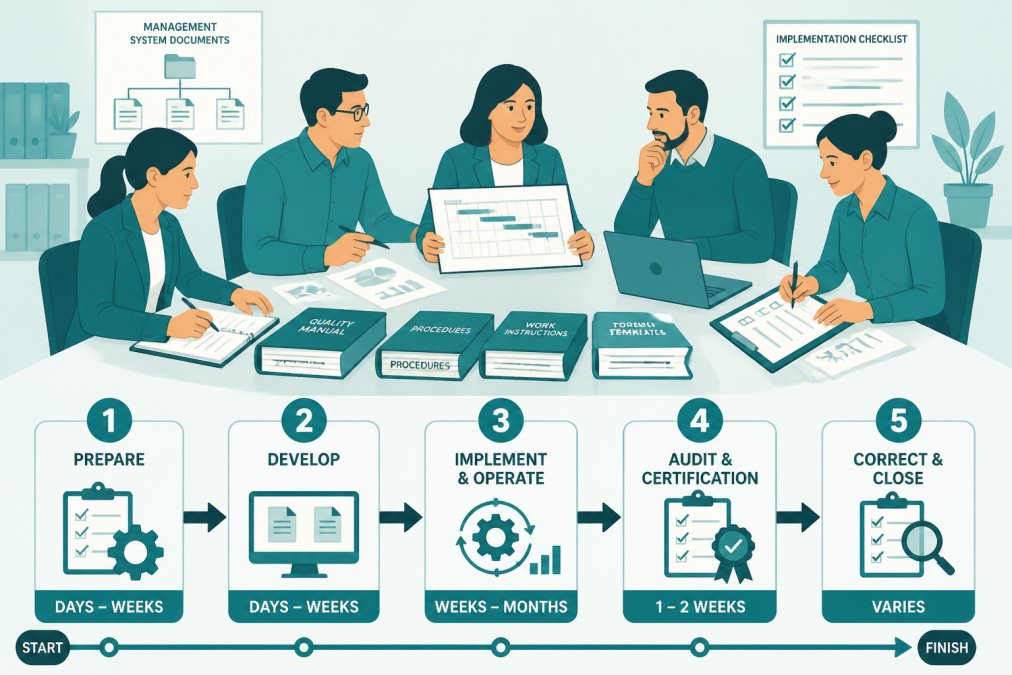
How long does ISO 9001 certification take? The answer depends on four distinct phases, each with its own timeline. At IntegriSURE, we break the journey into develop, operate, certify, and maintain.
The total time for the full journey varies with your starting point and resources. Some phases move quickly; others need time to build evidence that your system works.
Phase 1: Develop Your Management System
Developing your quality management system (QMS) is where you create the foundation. This includes writing your quality policy, mapping processes, documenting procedures, and preparing forms and registers.
With focused effort and the right templates, this phase can be completed efficiently.
Generic templates save time. Customising them to reflect your actual operations takes longer but produces a system your team will use.
Phase 2: Operate and Gather Evidence
After developing your system, you must operate it. This means running your processes, completing procedures, recording data, and building the evidence that your system works.
This phase is often the longest. Your certification body will want to see:
- Records showing processes have run multiple times
- Evidence that procedures are being followed
- Data from internal audits and management reviews
- Training records and staff awareness
- Corrective actions where issues were found
The length depends on your business cycle. A manufacturer with monthly production cycles gathers evidence faster than a service business with longer project timescales.
Phase 3: Get Certified
Once your system is developed and operating, you're ready for the certification audit.
The certification body will conduct a Stage 1 audit (document and readiness review) and a Stage 2 audit (full system assessment).
After the Stage 2 audit, the certification body reviews its findings. With no major nonconformities, you'll receive your certificate. If corrections are needed, the time allowed for corrections will vary depending on findings.
Phase 4: Maintain Your Certificate
Your ISO 9001 certificate is valid for three years. During this time, you'll have surveillance audits (typically annually) to confirm your system continues to operate effectively.
Maintenance is ongoing: internal audits, management reviews, procedure updates and staff training. This isn't a one-time effort; it's how you keep the system valuable.
ISO 9001 Implementation Timeline: Realistic Ranges
The total time from start to certification varies based on organisation size and complexity. Here's what to expect.
Small organisations (20-50 employees)
Small organisations often move faster because their processes are less complex and their teams more agile.
Small teams can dedicate focused effort, often with one project owner supported by department heads, which speeds progress.
Medium organisations (51-250 employees)
Medium organisations have more processes to document and people to align. Coordination takes longer, but you typically have dedicated resources.
Expect longer operating periods to gather evidence from multiple departments and business cycles, plus more time to schedule audits across teams.
Larger organisations and multiple sites
Large and multi-site organisations face more complexity: more documentation and coordinated audits and evidence across locations.
Multi-site organisations often need a dedicated project manager, and audits across locations extend the timeline.
Factors That Affect Your ISO 9001 Certification Timeline
Several factors influence your timeline. Understanding them helps you estimate your own schedule.
Process maturity and documentation readiness
If you already have documented processes, you're ahead: you'll adapt existing documentation rather than create from scratch.
Starting from zero takes longer: you'll map processes, identify gaps and build procedures from the ground up.
What slows this down:
- Processes that aren't clearly defined
- Inconsistent ways of doing things across teams
- Outdated or scattered documentation
- Resistance to standardising how work gets done
Organisational size and complexity
Larger organisations have more processes to document and more people to train. More complexity means longer timelines.
A 25-person business certifies faster than a 200-person one. A single-site operation moves quicker than a multi-site network.
What affects timing:
- Number of departments and teams
- Number of business locations
- Complexity of your products or services
- Regulatory requirements in your industry
Resource availability and team engagement
How much time your team can dedicate matters. If one person juggles certification alongside their normal job, progress slows.
Organisations with a dedicated project owner and allocated implementation time move faster, and teams that understand why certification matters engage more actively.
What helps:
- A clear project owner with authority
- Time allocated for implementation (not just squeezed in)
- Buy-in from leadership and staff
- Regular communication about progress
Certification body scheduling and audit findings
Your certification body's availability affects timing. If they're busy, you may wait weeks for your audit date.
Audit findings matter too. Major nonconformities from Stage 2 need time to correct before you receive your certificate; minor findings are quicker to address.
What you can't always control:
- Certification body availability
- Number and severity of audit findings
- Time needed for corrective actions
Understanding the ISO 9001 Certification Audit Process
The certification audit has distinct stages. Knowing each helps you prepare and estimate timing.
Stage 1 audit: Document and readiness review
The Stage 1 audit is a document and readiness review. The certification body checks that your documented system meets ISO 9001 requirements and that you're ready for the full audit.
This typically takes 1-3 days depending on your organisation size. It's less intensive than Stage 2.
What the auditor reviews:
- Your quality policy and quality objectives
- Process documentation and procedure manuals
- Evidence that your system is operating
- Your readiness to undergo the full audit
The auditor may identify gaps or areas needing attention before Stage 2. You'll have time to address these.
Stage 2 audit: Full system assessment
The Stage 2 audit is the full assessment: the auditor observes processes, interviews staff, reviews records and confirms your system operates as documented.
This typically takes 2-5 days depending on your size and complexity. The auditor will visit different departments, observe work, and check evidence.
Get Your Free ISO Starter Pack →
What happens during Stage 2:
- The auditor observes processes in action
- Staff are interviewed about their roles and understanding
- Records and evidence are reviewed
- Nonconformities or observations are documented
- The auditor provides feedback on findings
Audit findings and corrective actions
After Stage 2, the certification body classifies findings as:
- Nonconformities: Failures to meet ISO 9001 requirements
- Observations: Areas for improvement (not failures)
Major nonconformities must be corrected before you receive your certificate. The certification body typically gives 30 days to address them.
Minor nonconformities or observations can often be addressed within your normal management review cycle.
ISO 9001 Certification Requirements: What You Must Have Ready
Certification readiness isn't just about completing documents. Your system must be implemented and operating. Here's what auditors expect to see.
Documented quality management system
Your QMS documentation must cover all processes required by ISO 9001. This includes:
- Quality policy and quality objectives
- Process maps showing how work flows
- Procedures for key processes
- Work instructions where detail is needed
- Forms and templates for recording information
The documentation must be current and reflect how your organisation actually works. Out-of-date procedures raise red flags.
Operating procedures and process evidence
Documents alone aren't enough. You must show your system is actually running.
Evidence includes:
- Records from completed processes (orders, inspections, deliveries)
- Training records showing staff are aware of procedures
- Internal audit reports
- Management review minutes
- Customer feedback records
- Corrective action records
- Calibration records for equipment
The auditor will review these records and often observe processes in action.
Internal audits and management review records
You must conduct internal audits to check your system is working. These are audits you perform yourself, not the certification audit.
Internal audits typically happen quarterly or annually depending on your size.
Management reviews are formal meetings where leadership reviews system performance, discusses internal audit findings, and makes decisions about improvements.
Both must be documented and show evidence of action taken.
ISO 9001 Certification Maintenance: Beyond the Certificate
Receiving your certificate is a milestone, not an endpoint. Maintaining your system requires ongoing effort.
Surveillance audits and annual requirements
After certification, your certification body conducts surveillance audits, typically once per year. These are shorter audits (usually 1-2 days) that confirm your system continues to operate effectively.
During surveillance audits, the auditor reviews:
- Recent internal audit reports
- Management review records
- Any changes to your processes or organisation
- Corrective actions from previous audits
- Staff training and awareness
You must be ready to demonstrate your system is still operating and delivering results.
Recertification every three years
Your ISO 9001 certificate is valid for three years. After three years, you'll undergo a recertification audit (similar to your initial Stage 2 audit) to renew your certificate.
This is a full reassessment of your system. It's your opportunity to show improvements and address any areas that have drifted.
Ongoing system improvement and documentation updates
Maintaining your certificate means keeping your system current. As your organisation changes, your procedures must change too.
Update your documentation when:
- Processes change
- New equipment or technology is introduced
- Staff roles change
- Regulatory requirements change
- Customer requirements change
- You identify improvements through internal audits
Regular updates keep your system relevant and prevent your documentation from becoming outdated.
How to Prepare and Shorten Your Certification Timeline
Several strategies help organisations move through certification faster without compromising quality.
Conduct a gap analysis early
Before you start developing your system, understand where you stand. A gap analysis compares your current processes against ISO 9001 requirements.
This identifies what you already have, what needs documenting, and what's genuinely missing. It prevents wasted effort documenting things that already work.
Plan and resource your implementation
Assign a dedicated project owner. Give them authority and time to drive the project forward.
Create a realistic timeline. Break implementation into phases. Identify which teams need to do what and by when.
Communicate the plan to your whole organisation. People work faster when they understand why certification matters.
Train your team and build capability
Your team needs to understand the system and their role in it. Training isn't a one-time event.
Conduct training before you start operating the system. Reinforce it through internal audits and management reviews. Build capability so your team can maintain the system without external support.
Use structured implementation support
This is where platforms like IntegriSURE help. Ready-made templates, step-by-step guidance, and implementation tools compress timelines significantly.
Instead of building from scratch, you adapt templates to your organisation. Instead of guessing what's needed, you follow a structured pathway. Our webinars at IntegriSURE webinars step through the four phases in detail, showing exactly what happens in each and how long each typically takes.
The four phases, develop, operate, certify, and maintain, each take different amounts of time.
Start with a clear gap analysis. Assign a dedicated project owner.
The real value of ISO 9001 certification comes after you receive your certificate.
Frequently Asked Questions
How long does an ISO 9001 certification audit take?
The full ISO 9001 certification audit process typically takes 1-2 weeks on site, depending on organisation size and complexity. Stage 1 (document review) is usually 1-2 days, and Stage 2 (full system assessment) takes 2-5 days for smaller organisations, longer for larger ones. After audit completion, you may need additional time to address findings before receiving your certificate.
What can delay ISO 9001 certification?
Several factors delay certification: insufficient operating evidence (your system hasn't run long enough), audit findings requiring corrective actions, incomplete documentation, staff training gaps, or certification body scheduling delays. Planning ahead and ensuring your system operates for adequate time before audit scheduling helps minimise these delays significantly.
How long should a quality management system operate before ISO 9001 certification?
Your quality management system should operate for at least 2-3 months before your Stage 2 audit to generate sufficient evidence of implementation. For organisations with complex processes or multiple sites, 4-6 months is more realistic. This operating period allows you to collect process records, internal audit results, and management review documentation that auditors will assess.
How long does ISO 9001 certification last before renewal?
An ISO 9001 certificate is valid for three years from the date of issue. During this period, you'll have annual surveillance audits (usually 1-2 days each) to confirm ongoing compliance. After three years, you undergo recertification audit, which is similar in scope to your initial Stage 2 audit.