 comparison
7 Ways to Get ISO Certification Without Ongoing Software Fees
Last Updated: November 3, 2026
Quick Summary
You can get ISO certification without ongoing software fees by building your management system once using editable, clause-mapped templates that you own outright. The standards require no software at all, so the only mandatory costs are certification body audit fees and your internal effort.
- Understand requirements, map processes, assign responsibilities, implement controls and gather evidence before any monitoring tool.
- Certification bodies assess whether your system is implemented and operating, not which platform holds your records.
- Subscription fees compound over three to five years and may lock your documents and records into the platform.
- Ask whether documents are fully editable, whether you own them, and what the total three-year cost is.
- Build once is not set and forget: internal audits, management reviews and surveillance audits continue after certification.
Table of Contents
- What Must Be Established Before You Monitor Compliance
- Why Monitoring Isn't Implementation: The Case for Building First
- When ISO Implementation Software Helps and When It's Overkill
- Using ISO Management System Templates to Build Your System Once
- ISO Consultant vs Software: Comparing Cost and Control
- ISO Certification Preparation Without Recurring Fees
- What to Ask Before Buying Any ISO Tool or Template Package
- Compare IntegriSURE Packages and Start Building Your System
- Frequently Asked Questions
What Must Be Established Before You Monitor Compliance
ISO certification without ongoing compliance software fees starts with a simple truth: you cannot monitor a system that does not yet exist.
A common pattern is for a business to buy a monitoring tool, then discover it has nothing structured to monitor.
The establishment phase covers five practical actions:
- Understand the requirements. Read ISO 9001, ISO 14001 or ISO 45001 clause by clause and note what applies to your scope.
- Map existing processes. Keep what works. Most SMEs already run effective processes that simply need documenting.
- Assign responsibilities. Name who owns each process, each risk and each piece of documented information.
- Implement controls. Put the process in place and run it, rather than writing a procedure you never follow.
- Gather evidence. Keep records that show the system operates as described.
Monitoring comes after this foundation. A gap analysis checklist helps identify what already exists and what genuinely needs building.
Why Monitoring Isn't Implementation: The Case for Building First
Monitoring is a review activity. Implementation is a doing activity.
A dashboard showing red statuses does not create a risk assessment. An audit reminder does not write your internal audit procedure.
The practical consequence is predictable. Teams spend weeks configuring software, then realise the underlying processes were never defined. The tool becomes a monument to good intentions.
Certification bodies assess whether your management system is implemented and operating, not whether you own monitoring technology.
When ISO Implementation Software Helps and When It's Overkill
ISO implementation software earns its place in specific circumstances. It is overkill in others. Enterprise compliance platforms are often a poor fit for SMEs establishing their first system.
Software helps when:
- Multiple sites or teams need a shared evidence repository
- The management system is mature and needs continuous monitoring across many processes
- Audit trails and version control are genuinely difficult to maintain manually
- Your organisation already runs complex systems and needs automation to keep pace
Software is overkill when:
- You are building your first management system and processes are still being defined
- Your team is small and processes are straightforward
- The recurring subscription adds cost before foundations exist
- You need editable documents and guidance more than dashboards
A common mistake is buying monitoring capability to solve a documentation problem. The real gap is usually structured, editable content and a clear pathway, not another login.
Using ISO Management System Templates to Build Your System Once
ISO management system templates give an organisation a structured starting point: editable policies, procedures, forms and registers aligned to the standard's clauses.
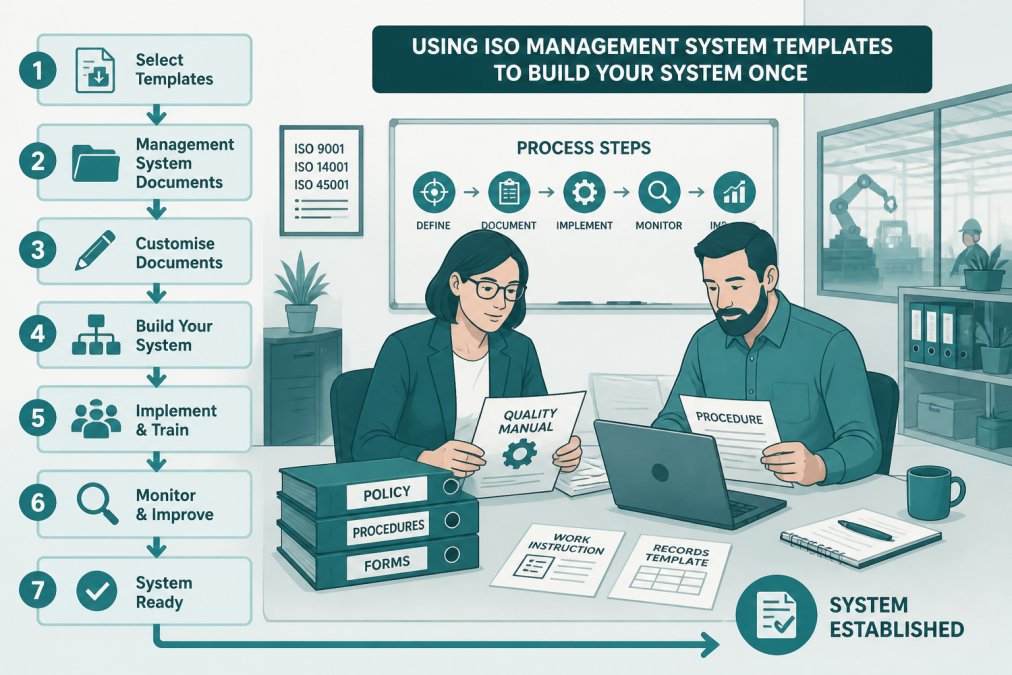
IntegriSURE packages provide editable documents mapped clause by clause, so a team can retain suitable existing processes and address genuine compliance gaps rather than starting from a blank page. A one-off template package suits organisations that want a build-it-once approach without recurring fees.
The build-once model works because the documents become yours. You adapt them to your operations, your risks and your scope.
Watch out: a template is a starting point, not a finished system. Copying documents without tailoring them to your actual processes produces paperwork that will not survive an external audit.
ISO Consultant vs Software: Comparing Cost and Control
The ISO consultant versus software question usually frames a false choice. Both offer something valuable, and both carry trade-offs worth understanding before committing. The more useful question is which costs are mandatory for certification and which are optional add-ons you can decline.
Separate the mandatory from the optional
ISO 9001, ISO 14001 and ISO 45001 do not require you to buy any software. The standards specify requirements for a management system; they do not prescribe the tools you use to run it. A certification body accredited by JAS-ANZ assesses whether your system is implemented and operating, not which platform holds your records.
The costs that are genuinely part of certification are:
- Certification body fees for the Stage 1 and Stage 2 audits, then surveillance audits in years one and two and a recertification audit in year three.
- Internal effort to build, operate and review the system, the largest cost for most SMEs, and one that exists whichever approach you choose.
- Any external expertise you choose to buy, whether that is a consultant, a template package or a software subscription.
Only the third line is discretionary. That is where the real comparison sits.
How each approach actually charges
| Approach | Upfront cost | Ongoing cost | Control | Best for |
|---|---|---|---|---|
| Consultant-led | Higher, usually quoted per project or per day | May recur for maintenance, surveillance support or system updates | Lower, consultant-dependent | Complex or multi-site systems, or teams with very limited internal capacity |
| Subscription software | Lower entry point | Recurring monthly or annual fees, often per user or per site | Medium, platform-dependent | Mature systems needing automation across many processes |
| One-off template package | Clear upfront cost | None mandatory; support may cost extra | High, organisation owns the system | SMEs building their first system |
A consultant typically prices by project scope or day rate, and the figure depends on how much of the system they build versus how much your team builds. Subscription platforms usually charge per user, per site or per module, which means the cost grows as your team and scope grow. The system you tailor from a template package is yours to keep using.
Get Your Free ISO Starter Pack →
The multi-year view
A single-year comparison can mislead. Subscription fees compound: a modest monthly charge becomes a substantial three-to-five-year total, and it continues whether or not you use the platform heavily in a given year.
A one-off package front-loads the cost.
Watch out: a consultant-led "lift-and-shift" implementation can impose a template that ignores how your business actually works, leaving you with a system your team does not understand and cannot maintain without the consultant.
Check the exit terms before you commit
Lock-in is the hidden cost in subscription models. Before signing, confirm whether you can export your documents and records in a usable format, what happens to your data if you stop paying, and whether the licence covers multiple users or sites.
Template packages can offer greater control over your system. If you are weighing that path, read whether you can get ISO certified without a consultant, and review current package pricing to compare against consultant and subscription costs.
ISO Certification Preparation Without Recurring Fees
ISO certification preparation without recurring fees is achievable when the organisation owns its documents, understands its requirements and follows a structured pathway. The work is the same either way: define the system, operate it, gather evidence and prepare for the certification audit.
A practical preparation sequence:
- Confirm your scope and the standard edition that applies
- Complete a gap analysis against the clause requirements
- Build or tailor documented information
- Implement processes and run them long enough to generate evidence
- Conduct an internal audit and a management review
- Address nonconformities and corrective actions
- Engage an accredited certification body for the external audit
Each step produces evidence the certification body will examine.
"Build once" is not "set and forget." Systems need ongoing operation, review and improvement. Internal audits, management reviews and corrective actions continue after certification. Surveillance audits and recertification keep the certificate valid.
What to Ask Before Buying Any ISO Tool or Template Package
Before committing to any ISO tool or template package, ask questions that separate genuine value from recurring cost. A checklist is only useful if you know what a good answer sounds like, so here is each question with the reasoning behind it.
Ownership and editing
- Are the documents fully editable, and do I own them after purchase? If the answer is no, you are renting your management system. Editable documents let you tailor procedures to your actual operations and keep using them if you change providers.
- Can I export everything if I stop using the platform? Ask for the export format. A platform that only exports in a proprietary format you cannot open elsewhere is a lock-in risk.
Fees and licensing
- Is there a mandatory subscription, or is it optional? Some providers bundle a compulsory ongoing fee into what looks like a one-off purchase. Confirm the total cost over three years, not just the entry price.
- What are the licensing terms for multiple users or sites? Per-user and per-site charges can multiply quickly. Confirm whether the licence covers your whole team or only named users.
- Are updates to standards editions included? Standards are revised from time to time. Ask whether updates to the documents are included or charged separately.
Coverage and support
- Which standards and clauses are covered? Confirm the package maps to the edition of ISO 9001, ISO 14001 or ISO 45001 you are certifying against, and that it covers your scope.
- Does the package include guidance, or documents only? Documents alone suit a team that already understands the standard. If you are new to ISO, guided learning and step-by-step instructions matter more than a folder of templates.
- What support is included, and does support cost extra? Support levels vary between packages. Ask what is included, what is charged separately, and how support is delivered.
The hidden cost of a software-free approach
A one-off package avoids recurring fees, but it is not free of effort.
The honest comparison is between recurring platform fees and the internal hours you would otherwise spend.
Watch out: buying monitoring capability to solve a documentation problem is a common and expensive mistake.
Inclusions vary between packages, and support levels differ. Check IntegriSURE's frequently asked questions for details on inclusions and support before you commit. Ask the same questions of any provider.
Compare IntegriSURE Packages and Start Building Your System
IntegriSURE is a hands-on, build-it-once implementation platform. Packages provide editable ISO-aligned documents and, depending on the package, implementation tools, guided learning, step-by-step guidance and support options.
Packages range from Basic through Essentials, Guided, Professional and Partnered. Inclusions and support levels vary, so compare them against your scope and internal capacity.
Independent certification remains separate and is never guaranteed by any tool or template. What you control is the quality of the system you build.
Structured where it matters. Flexible where it counts.
Frequently Asked Questions
Can a business achieve ISO certification without compliance software?
Yes. ISO standards require an implemented and operating management system, not a specific software product. You need documented information, evidence of processes in use, internal audits and management reviews. Many organisations prepare using editable templates and a document control structure, then engage an independent certification body for the audit. Software can help organise evidence, but it is not a certification requirement.
What is the difference between ISO implementation software and compliance monitoring software?
ISO implementation software helps you build the system: policies, procedures, risk assessments, registers and audit tools. Compliance monitoring software tracks ongoing status through dashboards, reminders and evidence repositories. Monitoring tools suit complex or multi-site operations, but they assume a system already exists. For a first certification, implementation support usually matters more than monitoring features.
Are one-off ISO implementation packages better than subscriptions?
It depends on your needs. Template packages let you own the tailored system you build from them. Subscriptions offer automation and updates but add ongoing costs and possible lock-in. Check what is included, how long you retain access, and whether support is extra. For SMEs building a first system, a one-time package with editable documents often provides better value.
Does buying ISO software or templates guarantee certification?
No. Certification depends on an independent certification body assessing whether your management system meets the standard and is operating effectively. Templates and tools help you prepare, but they do not guarantee an audit outcome. You must tailor documents to your operations, implement controls, gather evidence and address any nonconformities found during the audit.
The challenge is not finding more software. It is building a management system your team understands and owns. IntegriSURE provides editable management system documents, a built-in progress tracker and step-by-step guidance mapped clause by clause, with support available when you need it. Get started with IntegriSURE and build your ISO system once, on your terms.